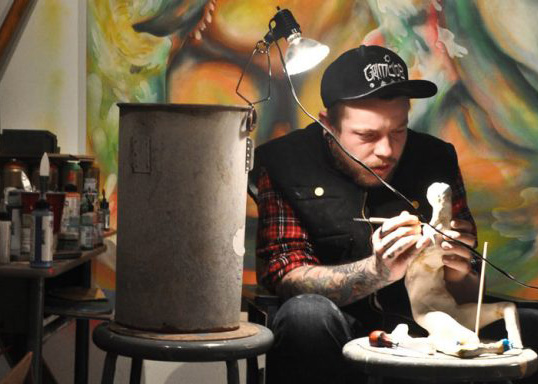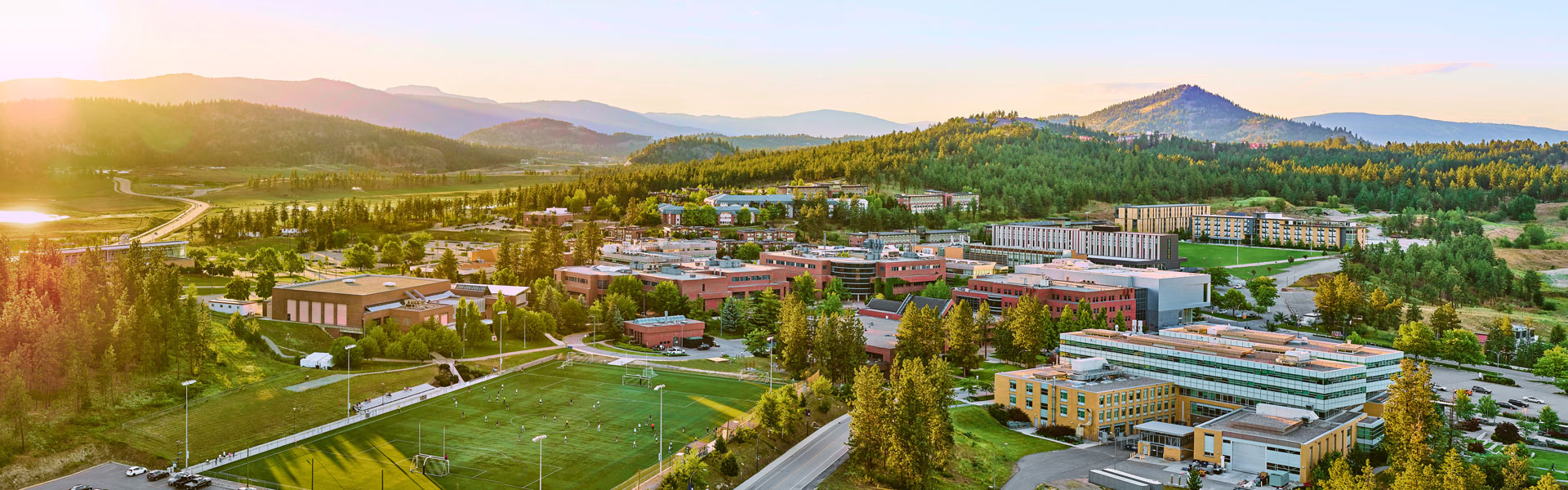


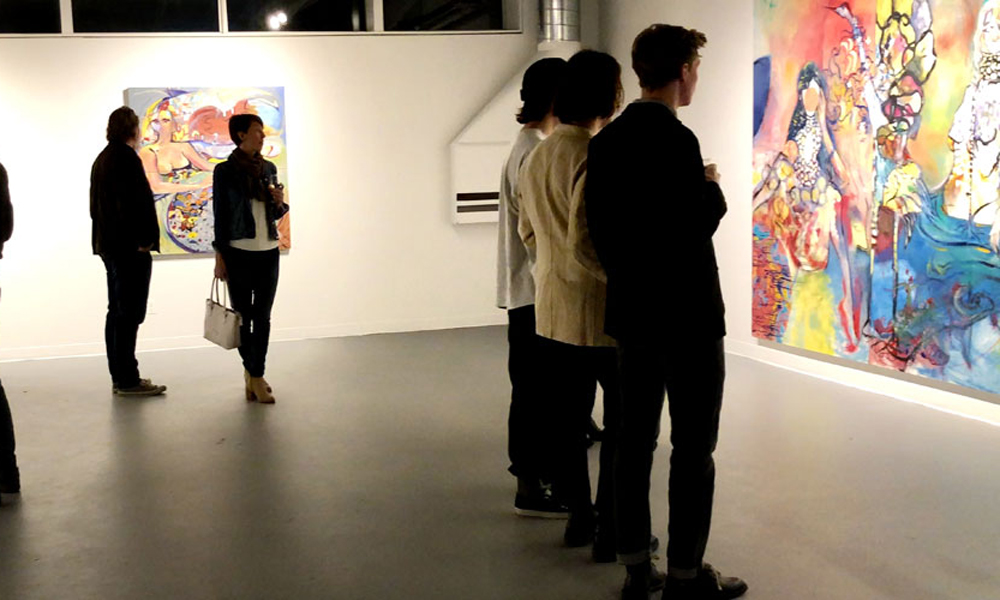
The new Bachelor of Fine Arts (BFA) in Interdisciplinary Performance offers artists a unique combination of courses in performance practice, visual arts, and creative writing. In this program, you will learn to work across the conventional boundaries that still separate the arts in most university and conservatory programs; gain a broader vision and experience of contemporary artistic practices; and develop a critical awareness of the creative processes that are vital to world cultures and traditions. Most importantly, you will acquire the tools you need to create your own work.
The program provides training in movement and voice, improvisation, mask, ensemble work, solo and collaborative performance creation, as well as courses in the history and theory of world performance practices and traditions. You also select courses from a wide range of artistic media including video art, film, photography, painting, sculpture, installation, as well as various genres in creative writing. All courses are taught by artists and scholars from the Faculty of Creative and Critical Studies who share a commitment to provide a supportive, student-centered learning environment.
The BFA in Interdisciplinary Performance will prepare you to work as an independent creative artist in the increasingly interdisciplinary and intercultural performance world. It will also open up career options in areas such as applied arts, scholarly research, education and health, digital arts, curating and cultural outreach.
To be admitted as a BFA student in Interdisciplinary Performance at UBC, Okanagan campus, you must have completed English 12 and other provincial grade 12 examinable courses. You must first make a general application to UBC and then make a specific application to the program. This includes an audition. Although in-person auditioning is highly recommended, you may submit a recorded audition if you are unable to travel to B.C. to attend the scheduled auditions.
For inquiries regarding auditions for Interdisciplinary Performance, please contact the Department of Creative Studies at 250.807.9648
Click here for online Audition Sign Up for the BFA in Interdisciplinary Performance.First Year (36 credits):
THTR 111 (3) (Intro to Theatre & World Performance Traditions)
THTR 101 (3) (Intro to Acting: Improvisation & the Body in Performance)
THTR 102 (3) (Actor's Process
THTR 280 (3/6) (Devised Public Performance)
CRWR 116 (3) (Intro to Creative Writing I)
CRWR 126 (3) (Intro to Creative Writing II)
CCS 100 (3) (Creative and Critical Forum I)
VISA 106 (3) (Introduction to New Media)
VISA 090 (0) (Safety Training)
Choose one of the following VISA course pairs for 6 credits.
VISA 102 (3) (2-D I) and VISA 103 (2-D II)
OR
VISA 104(3) (3-D I) and VISA 105 (3-D II)
Choose 2 English courses for 6 credits.
ENGL 112 (3)(Strategies for University)
ENGL 113 (3)(Reading across the Curriculum)
ENGL 114 (3)(University Writing: Aboriginal Perpectives)
ENGL 150 (3)(Readings in Poetry and Drama)
ENGL 151 (3)(Readings in Short fiction and the Novel)
ENGL 153 (3)(Readings in Narrative)
Second Year (33 credits):
THTR 211 (3)(Performance, embodiment and creativity)
THTR 201 (3)(Actor/Creator resources)
THTR 202 (3)(Actor's Process 2)
THTR 280 (3/6) (Devised Public Performance)
FILM 100 (3) (Intro to Film)
OR
THTR 103 (3) (Acting for Stage and Screen)
Choose 2 Creative Writing courses for 6 credits.
CRWR 216 (3) (Int. Workshop in Creative Writing: Poetry)
CRWR 217 (3) (Int. Workshop in Creative Writing: Fiction)
CRWR 218 (3) (Int. Workshop in Creative Writing: Drama)
CRWR 219 (3) (Int. Workshop in Creative Writing: Non-Fiction)
CRWR 260 (3) (Theory and Practice of Creative Writing)
Choose one of the following VISA course pairs for 6 credits.
VISA 215 (3) (Painting I) and VISA 225 (3) (Painting II)
VISA 233 (3) (Screenprint I) and VISA 253 (3) (Screenprint II
VISA 235 (3) (Sculpture I) and VISA 245 (3) (Sculpture II)
VISA 244 (3) (Photo I) and VISA 256 (3) (Photo II)
VISA 261 (3) (Video I) and VISA 271 (3) (Video II)
VISA 262 (3) (Lithography I) and VISA 272 (3) (Lithography II)
VISA 263 (3) (Intaglio/relief I) and VISA 273 (3) (Intaglio/relief II)
VISA 264 (3) (Computer I) and VISA 265 (3) (Computer II)
Elective (3)
Elective (3)
Third and Fourth years (57 credits):
THTR 411 (3) (Performance Studies)
THTR 301 (3) (Styles)
THTR 401 (3) (Live Art, New Media)
THTR 480 (3) (Special Topics in Performance Creation)
12 credits in THTR 482/483 (6) (Advanced Artist Practice)
6 credits in upper level ART HISTORY
12 credits in VISA (Attn: Pre-requisites)
Each of the following VISA courses can be taken more than once:
VISA 300 (3) (Adv. Drawing)
VISA 312 (3) (Adv. Painting)
VISA 322 (3) (Adv. Sculpture)
VISA 336 (3) (Adv. Printmaking)
VISA 362 (3) (Adv. Photography)
VISA 382 (3) (Adv. Media)
OR
12 credits in CREATIVE WRITING (Attn: Pre-requisites)
CRWR 380 (3)(Writing of the Short Story)
CRWR 381 (3)(Writing of Poetry)
CRWR 382 (3)(Topics in Creative Writing)
CRWR 383 (3)(Writing of the Novel)
CRWR 480 (6)(Portfolio)
CRWR 481 (6)(Advanced Theory and Practice)
15 credits in ELECTIVES
May include up to 6 credits in THTR 485 Directed Studies)
Elective
Elective
Elective
Elective
Elective
2 of these electives must be 300-400 level)
Total credits for INTP BFA: 126
Minor in INTP (no fewer than 36 credits):
First year:
THTR 111 (3) (Intro to Theatre & World Performance Traditions)
6 credits from: THTR 101, 102, 103
Second Year:
9 credits from: THTR 201, 202, 211, 280
Third and Fourth years:
THTR 301 (3) (Styles)
THTR 401 (3) (Live Art, New Media)
THTR 411 (3) (Performance Studies)
THTR 480 (3) (Special Topics in Performance Creation
6 credits in THTR 482/483 (6) (Advanced Artist Practice)
Faculty in Theatre/Performance are Neil Cadger, Denise Kenney and Virginie Magnat.
Devising is an interdisciplinary and intercultural approach to artistic creativity that draws from a wide variety of world performance traditions, including theatre, dance, music, visual arts, new media, circus, story-telling, folklore, and ritual. Whether or not they use this specific term, some of the most prominent artists that have made significant use of devising in their work include Jacques Copeau, Etienne Decroux, and Jacques Lecoq in physical theatre, Vsevolod Meyerhold, Bertold Brecht, and Augusto Boal in social and political theatre, Peter Brook, Jerzy Grotowski, Eugenio Barba, Tadashi Suzuki, and Ariane Mnouchkine in intercultural and experimental theatre, Pina Bausch, Anna Halprin, Merce Cunningham, John Cage, and Robert Rauschenberg in dance, music, and visual arts, as well as Robert Lepage, Anne Bogart, Robert Wilson, and Peter Sellars in multimedia and postmodern performance. These world-renowned artists all share the desire to explore creativity beyond psychological, behavioral or pictural realism, beyond conventional interpretations of dramatic texts, musical scores, and choreographies, and beyond the disciplinary categories that tend to separate artistic practices in contemporary Western culture. They believe that actors should learn to use their body, that dancers should learn to use their voice, and that both should be educated in visual arts and creative writing. They also often advocate collaborations between artists and scholars to optimize research in the fields of performance studies, anthropology, cultural theory, sociology, psychology, and neuroscience.
Although "devising" was coined by twentieth century theatre practitioners and has only recently begun to become integrated into university theatre programs in the U.K. and Australia, the practice of devising itself has a very long history. Indeed, it extends at least as far back as the Italian Commedia dell’Arte that flourished in the sixteenth century and influenced both Shakespeare and Molière. Of course, Commedia is itself rooted in the carnivals of the Middle Ages and the religious festivals of Ancient Greece.
Moreover, physically-based performance traditions have been transmitted across generations for thousands of years in China, Japan, India, Indonesia, Africa, and Latin America, as well as among indigenous peoples; the training developed by Western physical theatre practitioners is greatly indebted to the rigor and sophistication of the transmission process which has enabled such traditions to remain vibrant cultural processes in spite of colonialism, war, and poverty.
Given this wealth of sources and influences, devising is necessarily inclusive, collaborative, and innovative; it fosters a process-oriented learning environment in which personal growth and collective work are interrelated; it cherishes tradition, supports cultural diversity, and promotes cross-disciplinary and cross-cultural connections; it relies on the resources of the entire community to develop artistic projects that reflect the needs and aspirations of its contributors. Students enrolled in this program will therefore have the opportunity to explore performance-based practices and theories across disciplinary categories and cultural boundaries.
-Dr. Virginie Magnat
Last reviewed
9/14/2011 10:09:24 AM
new BFA in
Interdisciplinary Performance

Just Looking
live performance 2009
(34mb 7min iPod version)

This Neck Of The Woods
Quicktime H263 movie
5:36 - 21mb

365
Jen Lindahl slide show
2:28 - 38mb

Performance MFA and BFA
students in Poland
<(web gallery - summer 2009)
Click here to read about the
Laboratory of Creative Research.
Click here to link to
Inner Fish Performance Co.

Global Wakeup Flash Mob
Sept 21, 2009 Performance
(112mb m4v iPod version)

House At The End Of The Road
Vancouver, BC - 2010

Inner Fish
Live Performance 2009
(42mb m4v iPod version)

Ground Rules
Live Performance 2008
4:20 Flash movie
Neil Cadger
Associate Professor, Performance/Theatre
Faculty of Creative and Critical Studies
Tel: 250.807.9349
E-mail: neil.cadger@ubc.ca
Dr. Virginie Magnat
Assistant Professor, Performance/Theatre
Faculty of Creative and Critical Studies
Tel: 250.807.8441
E-mail: virginie.magnat@ubc.ca
Denise Kenney
Assistant Professor, Performance/Theatre
Faculty of Creative and Critical Studies
Tel: 250.807.9632
Email: denise.kenney@ubc.ca